Book RSS feeds
Design calm update channels for releases, editions, chapters, catalog additions, and verified changes.
Plan a feed →BookRSS.com
A standards-first field guide to Book RSS feeds, e-book syndication, full-text workflows, library and marketplace catalogs, OCR, mobile readers, and responsible AI automation.
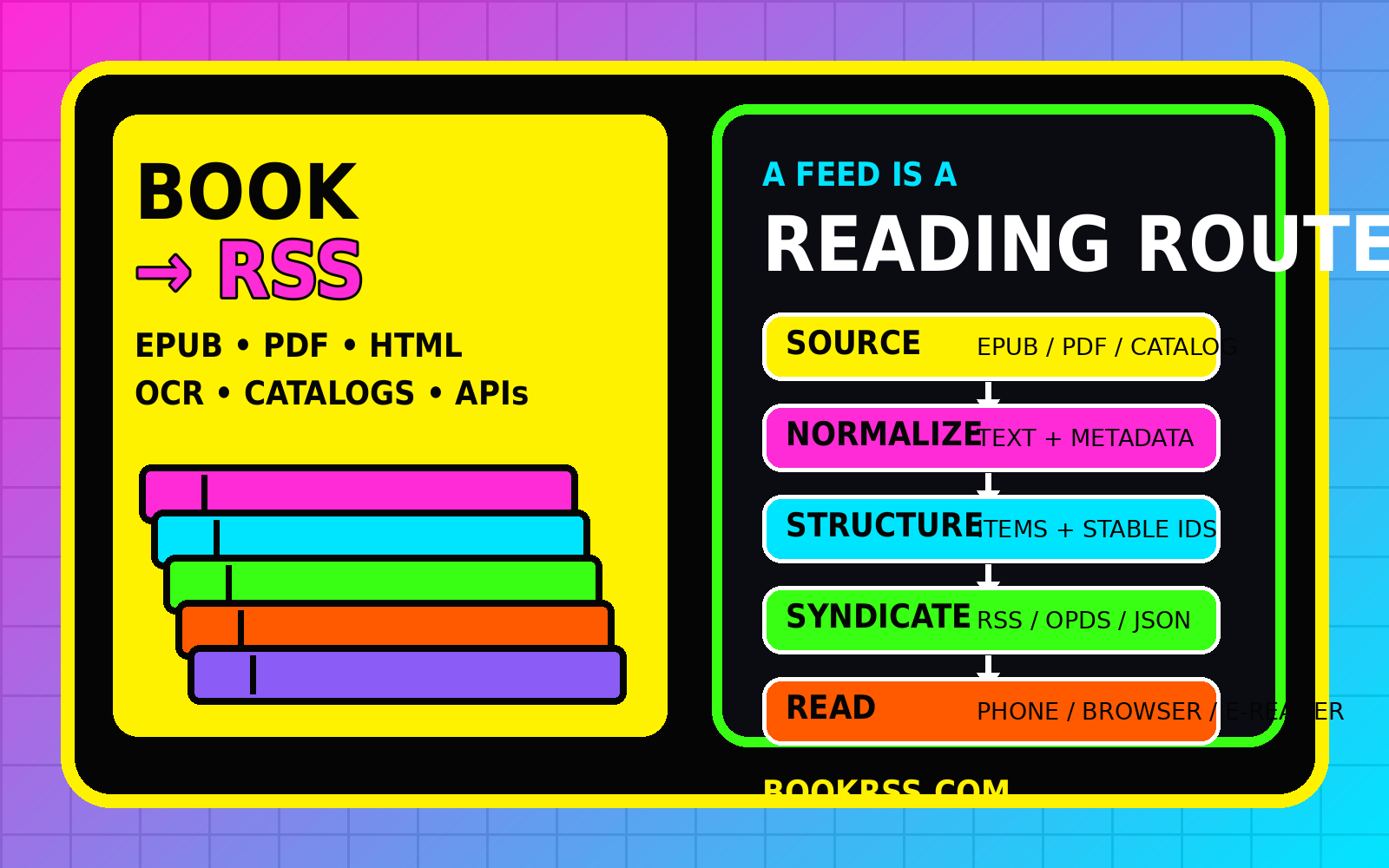
BookRSS.com separates discovery, delivery, catalog identity, and reading. That prevents a feed from becoming a confusing dump of files, listings, or unreviewed OCR.
Design calm update channels for releases, editions, chapters, catalog additions, and verified changes.
Plan a feed →Preserve structure, reading order, page context, and rights while translating sources into feed-friendly entries.
Compare workflows →Keep works, editions, holdings, resources, and offers distinct across library, new-book, and used-book records.
Map the metadata →Use stable IDs, cursor pagination, change streams, rights fields, and one source for RSS, OPDS, and JSON.
Explore the API blueprint →Use RSS for discovery, responsive HTML for context, EPUB for reflowable books, PDF for fixed pages, and OPDS for compatible catalogs.
Build a cross-device route →Distinguish owned, licensed, public-domain, excerpt-only, metadata-only, and restricted material before publishing.
Use the rights checklist →One normalized record set can drive canonical pages, RSS updates, OPDS collections, JSON APIs, and reader handoffs without letting titles, dates, or rights drift.
A feed for an author is not the same as a feed for OCR scans, city guides, new releases, or used-book price alerts. The item model should reflect the event.
Announce meaningful publication events with stable edition identity and clear access labels.
Translate catalog activity into reader-friendly updates while preserving identifiers and live availability links.
Publish reviewed milestones with page references, confidence context, and explicit distribution rights.
Combine destination identity, edition freshness, and location-aware filters without confusing history with current advice.
Separate bibliographic editions from temporary offers, prices, conditions, and seller observations.
Let models propose classifications, summaries, and review flags while code enforces identity, dates, links, rights, and valid feed output.
Ten complete field guides cover the decisions behind useful book feeds—from EPUB packages and OCR review to marketplace alerts and agentic workflows.

Use AI to assist book-feed classification, summaries, OCR review, and routing while preserving provenance, human oversight, and distribution rights.
Read the guide →
Create useful used-book alerts by separating bibliographic records from seller offers, normalizing condition, and preventing noisy price-change feeds.
Read the guide →
Combine book metadata, place identity, map coordinates, edition freshness, and regional access into useful travel- and city-guide feeds.
Read the guide →
Plan a cross-device reading route that uses feeds for discovery, canonical web pages for context, and EPUB or OPDS for full publication access.
Read the guide →
Design a book-feed API that supports RSS, OPDS, and applications with durable identifiers, predictable pagination, and clear change semantics.
Read the guide →
Build useful library and collection feeds by defining record identity, edition boundaries, update events, and transparent metadata provenance.
Read the guide →Start with the purpose of the feed, then choose the smallest representation that preserves identity, context, access, and rights.
No. It is a practical label for syndicating book-related updates. RSS can announce changes, OPDS can describe publication catalogs, and APIs can support specialized applications.
A feed can link to or enclose an authorized EPUB file, but the feed should not pretend to replace an EPUB reading system. Summaries, chapters, and downloads need distinct rules.
Only when the project has a sound rights basis. OCR also needs review, page references, and a visible distinction between the source scan and derived text.
RSS is a chronological update stream. OPDS is designed for publication discovery and acquisition relationships. Many projects benefit from publishing both from one record set.
This site provides architecture and editorial guidance. Production integrations must use supported APIs, exports, or agreements and follow each source’s access and display terms.
No. BookRSS.com is a static educational resource. It does not host copyrighted books, process uploads, operate accounts, or expose a live catalog service.